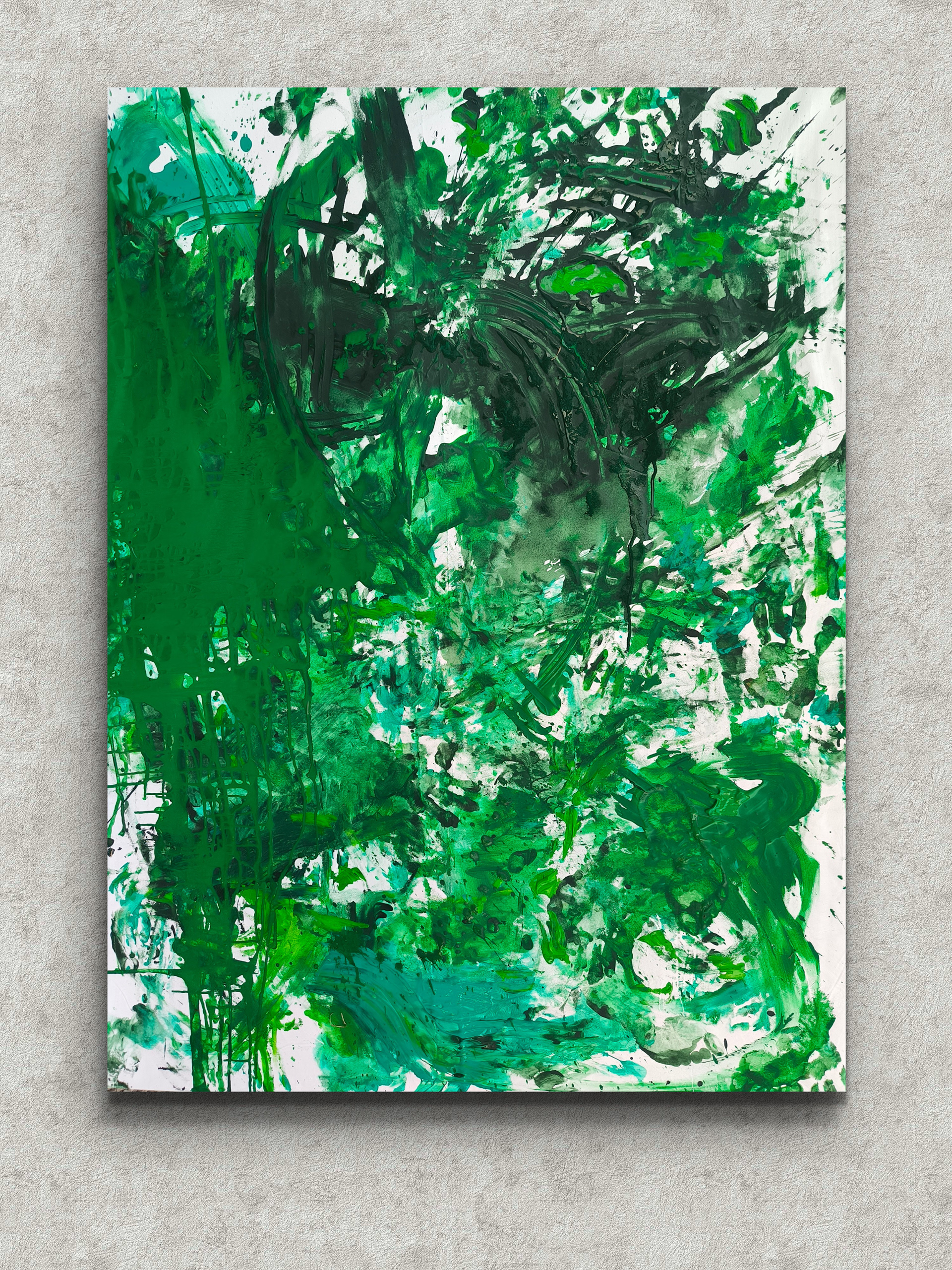
I have spent most of my life moving.
As a dancer, I learned to understand the world through the body. Movement exists intensely, but only for a moment. A gesture appears and disappears. A body crosses a space and leaves nothing visible behind.
As a painter, I became fascinated by the opposite. A mark remains.
Trace of Movement was born somewhere between these two worlds.
I began to ask myself what would happen if movement itself could become a way of painting. What if the body was not simply the subject of an artwork, but the tool that created it? What kind of trace would a fall leave? A rotation? A sudden impulse, a shift of weight, repetition, stillness?
Instead of painting movement, I began painting through movement.
Each work is created as a physical process. The body moves, touches, drags, presses, repeats and responds to the surface. Paint records something that would otherwise disappear. The finished painting becomes a kind of archive — a physical memory of an action that no longer exists.
This is why the idea of a trace became so important to me.
A footprint, a fossil, a mark left on a surface — they all tell us that something was once there. We may no longer see the movement itself, but we can encounter what it left behind.
The body moves.
The movement disappears.
The trace remains.
The movement disappears.
The trace remains.
Through Trace of Movement, I want to explore the space where dance and painting cease to be separate disciplines. Where the body can draw, movement can become material, and a painting can hold the memory of something that once happened.